
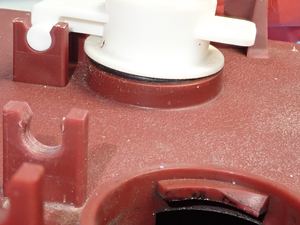
Figure 1. A battery from the same bank after the spark-ignition test: one vent cap still in place, the neighboring cap blown off. |
A 6-volt flooded lead-acid battery exploded on a houseboat while a worker was doing maintenance in the compartment that housed it, injuring his eye and elbow. The battery was one of eight wired together as the boat’s 12-volt bank for a solar (photovoltaic) power system. As the worker was leaving the compartment, he heard a nearby high-pressure water pump start, saw a flash, and the battery exploded.
Flooded lead-acid batteries normally give off small amounts of hydrogen and oxygen while charging. Each cell is closed with a vent cap that lets the gas escape. The cap carries a seal and a flame arrestor, a porous disk that lets gas out but is meant to stop an outside spark or flame from traveling back into the cell. If a flame gets past it, the hydrogen-oxygen mixture inside the cell ignites and can burst the battery.
Dirk Duffner, P.E. examined and measured ten batteries: the eight from the bank, including the one that exploded, and two replacements. The exploded battery was missing two of its three vent caps. On every cell, a mismatch in dimensions between the cap, its hinge and the cell made the cap sit unevenly, so its O-ring seal was squeezed harder at the front than at the back.
The leak and spark-ignition tests on batteries from the same bank had been run earlier by another laboratory, and Dirk reviewed the videos of those tests. In soap-solution leak tests on a charging battery, the videos showed no leakage at the O-ring seals. In the spark-ignition test, which followed SAE J1495 (the test procedure for battery flame-retardant venting systems), a battery from the bank exploded 42 seconds into the test. The explosion started at a vent cap, blew off two caps and cracked the case.
The conclusion: hydrogen and oxygen vented from the battery bank were ignited by a spark from the nearby water pump motor. The flame flashed back to the batteries and past a faulty flame arrestor in at least one vent cap of the battery that exploded, igniting the gas inside the cell. The uneven cap fit was a design defect shared by every cell examined, but it was too small to let gas leak past the O-ring seal and did not cause the explosion.